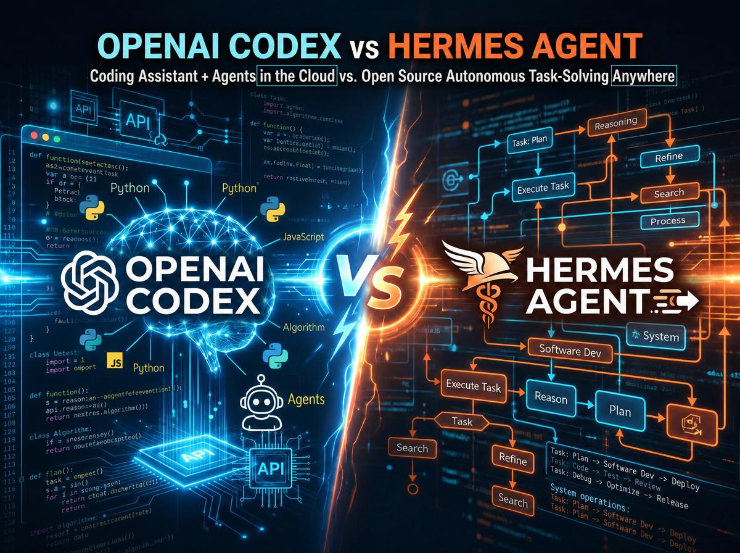
OpenAI’s Codex and Anthropic’s Claude Code keep adding useful features to their coding assistants, which I’m glad for because I like competition. Cool stuff!
Until you dig a bit.
Much like OpenClaw (the first to make a big splash way back in the dark ages of AI, December 2025), Hermes Agent can do all that and more with added benefits including but not limited to:
Hermes Agent is 100% free & open source; lives anywhere you want (on your main computer, on a laptop, on a VPS, etc.), not restricted to OpenAI’s or Anthropic’s gardens.
Hermes Agent was designed/built from the ground-up to be self-improving/learning agent with easy-to-create persistent parallel independent agents (that run 24/7 at any time you want), each being able to spawn/delegate as needed. After using Hermes for a couple months, I wondered, “Can I make the leap from using a coding assistant for my software dev TO setting up some agents in Hermes focused on software dev (give them dev-related skills, etc.) and point them at the projects?” Hint: Yes.
Freedom to choose your LLM
Hermes is “bring your own key” in how it gets its stable of LLM models (its “brains”): You can use local LLMs, subscriptions (including using the OpenAI Codex subscription to get less expensive use of the latest GPTs but can’t use Anthropic’s subscriptions because they banned competition from using theirs), and API keys. Freedom to run your system as you like!
Why care about being able to run a local LLM?
Briefly, why does it matter that Hermes allows use of local LLMs? As the big players (primarily OpenAI, Anthropic, and Google) get more deeply in bed with government as well as push for more regulation to keep the dirty masses from using any other model-makers/providers, our choices become limited and *will* get more expensive. As smaller open source models get “smarter” and harder gets better at running them, an average person can increasingly afford to run those models locally on a computer in their house or small business. Benefits also include privacy; your data stays in your computers.
Better at software dev than coding assistants?
Six or so weeks in and the answer is YES! Hermes’ built-in “learning” and “memory” (that Codex and Claude Code only recently started adding in a semi-clunky way) makes a huge difference. I now have 14 agents (called “profiles” in Hermes) running in my Hermes. Each one has access to specific skills and knowledge/memories/learnings in order to best do its tasks. Some of those agents “own” a project. I talk to them in various ways, including through Telegram messenger! Imagine managing your software development from your phone! Oh and Hermes has a built-in Kanban board! Easily manage teams of agents!
Codex and Claude Code were designed/built to be coding assistants (like Cursor and many others), with persistent parallel agents and memory bolted on as an afterthought. Over the past 8 weeks or so, Codex gained ground (and even eventually added ability for you to download it and run it locally) and passed Claude Code due to its evolution into being a better tool and due to Anthropic’s many mis-steps and lie-exposures politically and in their treatment of developers.
Hermes Agent goes even further. Want different kinds of memory? SQL-based, vector-embeddings? Markdown only? A mix? You have full control.
Watch the animated musical story / prediction of where things could be going and how we get there. Trigger warning: Short version skips past the dark times. Longer version tells the whole story.