Let’s talk about AI trainers “stealing” people’s data or creations.
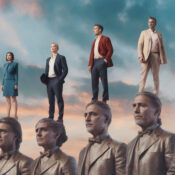
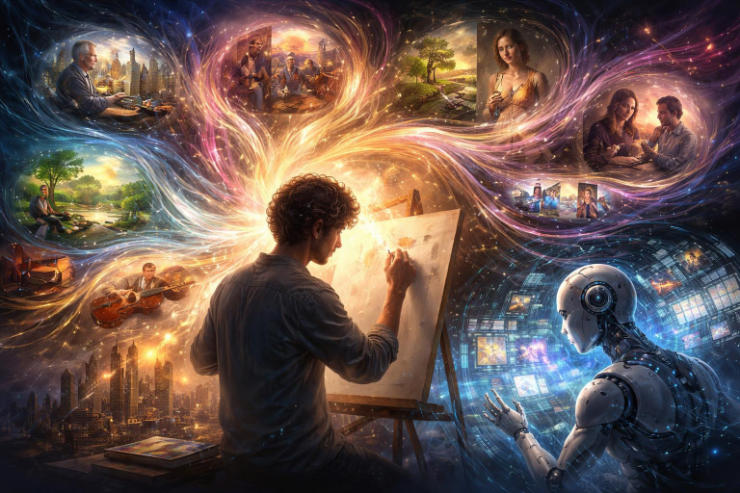
Every human artist spends their entire life training on the world around them – the songs they heard, the books they read, the paintings they stood in front of, the faces they gazed upon, the conversations they absorbed. Those inputs came from nature, from strangers, from artists who never knew they had a student, and from works the artist paid to experience and works they didn’t. All of it is absorbed into the mind, recombines in ways no one can trace, and eventually surfaces as something new. AI training on vast amounts of human-created work mirrors this process both ethically and, in meaningful ways, its mechanics. The influences are too diffuse, too numerous, and too thoroughly transformed to be owned by anyone. We don’t ask comedians to pay every friend who ever said something funny in their presence – and there’s no principled reason to treat AI any differently.
Interested in exploring this idea further?
On the surface a person might believe, “If we didn’t have intellectual property laws, it would open the floodgates for copycats everywhere, reducing incentive for people to create. We would have Chinese phones that look like iPhones and poor Apple! Innovation would be lost because no one needs to innovate in order to get sales.”
Yes, some entities will copy instead of innovate. Yes, many believe the government is the only way to prevent this scenario.
Nine points that weigh in favor of reforming or even completely removing intellectual property laws
(1) How many of these “copycats” will do this and be successful at it? Not everyone will do this or even want to. The fact that we have anything new in the world is a testament to that.
(2) Reputation, brand, first to market, quality, and integrity. These factors all influence the market and have value.
(3) Consumers win (price, etc.). Example: If a Chinese company succeeds in making an iPhone copy equal in every way (price, perceived quality/looks, AND quality), then one would assume they would try to sell it cheaper to draw away Apple customers. This is a big “IF” because Apple has agreements with their suppliers, economies of scale, etc. where it might be difficult for most companies to exactly dupe the iPhone in all ways, including quality, and afford to sell it cheaper. BUT let’s say they can. Then that means Apple is overpricing their product (it does cost Apple around $400 to make an iPhone X 2018), so the Chinese iPhone would force a market reckoning to a more fair price and keep Apple on their toes INNOVATING instead of SUING. The other, and more likely scenario is that the Chinese copy would be inferior. So yay, customers have a choice to buy the inferior version and save money. Given the number of tech review sites, word of mouth, Internet, etc., it would not be a secret for very long that the Chinese version is substandard. But hey if some people want a cheaper knockoff then why not?
(4) Joe Blow Middle Income Guy Inventor wants to make a new phone/OS that blows away Android and iOS. He has some revolutionary ideas but does need to at least use some of the basics that came before him, standing on the shoulders of his predecessors. Think touch screen or swiping or removable battery or long touch or… Get the point? But if you look at all the patents that exist in the phone market, you would see that Joe Blow has no chance in hell of creating his badass new phone/OS unless he joins Google/Apple or finds some super rich investor so he can afford licensing basic ideas from Google and Apple. Patents actually make it harder for the small guy!
(5) If Joe decides to stand on the shoulders of those before him and one of them uses the force of government to prosecute Joe, his time and efforts are being stolen.
(6) More often than not, copying increases the popularity of the author and/or work that was copied. Sure, there are cases where the opposite happens, but overall, publicity is good and “negative publicity is better than no publicity” is a saying for a reason. And heck, in this case, the “negative” publicity has the negative pointing at the copycat, not you.
(7) Removing patent/copyright law does not prevent creators from making private agreements to increase security for their innovative ideas.
(8) “Inventors and creators express a skill that CANNOT be copied, but it can be learned, and so a patent amounts to HIDING the value of the creators and inventors.” ~ Dave Scotese
(9) Copyrighting and patenting are often the reason a brilliant new idea gets stolen because these ideas are published where the public can see.
So yes, I believe that if we radically changed patent law or even removed it, some would copy even more than we see now but the real question is: when you consider the potential small negatives as well as the big positives [to removing all government-controlled copyrights and patenting] I mentioned above, will the net affect [to us all] of that happening be positive or negative? And bonus: less rules and less bureaucracy means a more efficient system!
From original article:
https://clearsay.net/can-you-own-an-idea
Common Objections
1. “But if anyone can copy your book/song/movie, creators won’t get paid and nothing new will be made!”
Answer: Creators were making brilliant work for centuries before copyright existed (Homer, Shakespeare, Bach – all freely borrowed plots, melodies, and techniques). Today, open-source software, recipes, fashion designs, and stand-up comedy routines all thrive *without* monopoly protection. The real money often comes from first-mover advantage, live performance, branding, patronage, merchandise, or simply being better/faster – not from suing copiers. Forcing everyone to pay a gatekeeper actually *slows* progress: patent thickets in tech and endless sampling lawsuits in music prove it.
2. “That’s stealing the creator’s livelihood!”
Answer: It’s not stealing – it’s competing. You still have your original copy, your skills, your reputation, and your ongoing ability to create. What you “lost” is only the *potential* monopoly profit you hoped the government would enforce for you. That’s not a property right; that’s a government-granted privilege. We don’t let bakers sue every other baker who uses flour and sugar the same way.
3. “But the creator put in all the work – they deserve to own the result!”
Answer: They absolutely own the *physical* result (the manuscript, the master recording, the prototype). No one is taking that. What they don’t “own” is the abstract pattern or sequence of words/notes/ideas inside it. Every single element of that pattern came from the shared cultural commons – language, math, physics, tropes, prior art. You didn’t invent the alphabet or the laws of physics. Rewarding the last step in a chain of thousands of free inputs with exclusive control over the whole chain is arbitrary.
4. “What about really original breakthroughs – shouldn’t the inventor get rich?”
Answer: They *can* get rich – by selling the first version, licensing voluntarily, or building a brand around being the best. History shows the biggest leaps (electricity, airplanes, the internet protocol) were often accelerated once the idea was free to iterate on. The monopoly model actually delays follow-on innovation because everyone has to wait 20 years or pay royalties. Copying is how humanity has always progressed: one person’s “theft” is the next person’s standing-on-the-shoulders-of-giants moment.
5. “Plagiarism is still wrong – you can’t just copy and claim it’s yours.”
Answer: Agreed – that’s fraud, not copying. If someone sells their version and lies about who made it, that’s false advertising. But if they clearly say “this is a cheaper version of X’s idea,” or “inspired by,” that’s honest competition. The IP system conflates the two on purpose to protect rents.
6. “Without IP, big companies would just copy everything and crush small creators.”
Answer: Big companies *already* use IP as a weapon to crush small creators (patent trolls, endless Disney copyright extensions). Without IP, small creators keep their lead through speed, community, and reputation – exactly like open-source developers do today against Microsoft and Google. The playing field actually levels when the legal monopoly weapon is removed.