
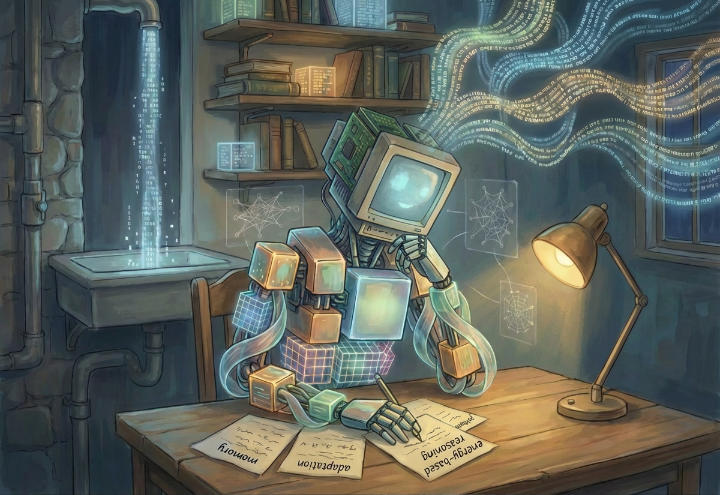
Let’s look at these post-LLM experiments. Not to worship them. Not to sneer at them. To understand what problem they’re trying to solve. And what emotional itch we’re scratching by chasing them.
Energy-Based Models: Can We Judge the Whole Story Instead of One Word at a Time?
Local token prediction is like finishing someone’s sentence at a dinner party. Sometimes charming. Often awkward. Energy-based models step back and score the entire sequence at once. The vibe becomes, “Does this whole story hang together?” instead of “Does the next word look fancy?”
NVIDIA introduced diffusion-style language systems that treat text more like a picture being refined than a sentence being typed. Notice the shift? From linear drip-drip generation to holistic evaluation. It mirrors therapy, oddly enough. We do not fix one word in your argument with your partner. We look at the pattern.
Eve Bodnia at Logical Intelligence has been exploring energy-based reasoning by assigning scalar scores to reasoning traces, effectively letting the model “feel” when a thought path is coherent or absurd. Think of it as emotional calibration for logic — failures and inconsistencies become visible, localizable bruises instead of mysterious misfires. This adds a layer of introspection the straight autoregressive route never bothered with.
Boltzmann-GPT splits the “world model” from the “language mouth.” I like that. It is similar to separating thoughts from reactions. One part simulates what is plausible. The other part speaks. When those collapse into one blob, you get confident nonsense. When you separate them, you can tweak beliefs without retraining the entire machine. Humans could learn from that.
Some teams even let you edit in latent space and watch failures localize like bruises on eternity. That is not magic. It is structure. Structure reduces chaos. Notice how that overlaps with emotional regulation? Same principle.
Diffusion Models: Parallel Refinement Instead of One-Track Thinking?
Masked diffusion models generate many tokens at once and refine them in parallel. InclusionAI scaled this idea up with LLaDA 2.1. It competes on math and code while letting you edit mid-generation. Translation: the draft is not sacred. You can reshape it while it forms.
Inception Labs built Mercury 2 and pushed multi-token denoising for lower latency. Faster output. Same core question: can we reduce the friction of generation without tanking coherence?
Here is what interests me. Parallel refinement mirrors how we revise our beliefs when we are grounded. You do not change one thought in isolation. You update clusters. Identity, memory, expectation. It is a batch update, not a single keystroke. The tech is trying to mimic that.
Will it fix everything? No. Tools do not remove human confusion. They amplify it if the foundation is shaky.
State-Space Models: The Linear Grind of Long Context
Attention scales poorly. It is like trying to maintain eye contact with ten million people at once. State-space models such as Mamba-2 aim for linear scaling across huge contexts. NVIDIA and Tencent are already blending these into production systems.
The appeal is simple: keep more memory without quadratic cost. In human terms, “Can I remember what we said 40 minutes ago without frying my brain?”
Longer context does not equal wisdom. It equals capacity. Capacity helps. It does not guarantee discernment. Same with us. You can remember every insult from 2009. That does not make you enlightened.
HOPE and Self-Modifying Systems: Adapt While Running
Google’s system called HOPE maintains hierarchical memory across massive token windows and updates its own learning rules during inference. That is a bold move. It adapts while operating.
Humans do this all the time. We update our internal rules mid-conversation. “Oh, I see, you value autonomy more than agreement.” Rule shift. Behavior shift.
The risk? Self-modification without guardrails becomes drift. If your inner algorithm rewrites itself based on fear, you spiral. If it rewrites based on curiosity, you grow. The mechanism is neutral. The direction matters.
The Hybrid Future: A Patchwork Organism
The frontier systems will blend transformers, state-space layers, energy functions, and adaptive memory. It will look messy. It will be messy. Evolution is messy.
We chase hybrids because single-paradigm purity feels clean but fails under pressure. Same in relationships. Pure logic fails. Pure emotion fails. Integration works better.
So am I impressed? Yes. Am I convinced this ends suffering? No. Technology reduces certain constraints and exposes others. It is a mirror. A fast one.
If you are hopeful, notice what you hope for. More speed? More coherence? Fewer hallucinations? Underneath those is a human need: predictability, reliability, relief from cognitive load.
And if you feel cynical, notice that. Cynicism is often disappointed hope wearing armor.
We keep iterating models because we keep iterating ourselves. The architecture changes. The questions remain.
Watch the animated musical story / prediction of where things could be going and how we get there. Trigger warning: It starts out dark.





Recent Comments