
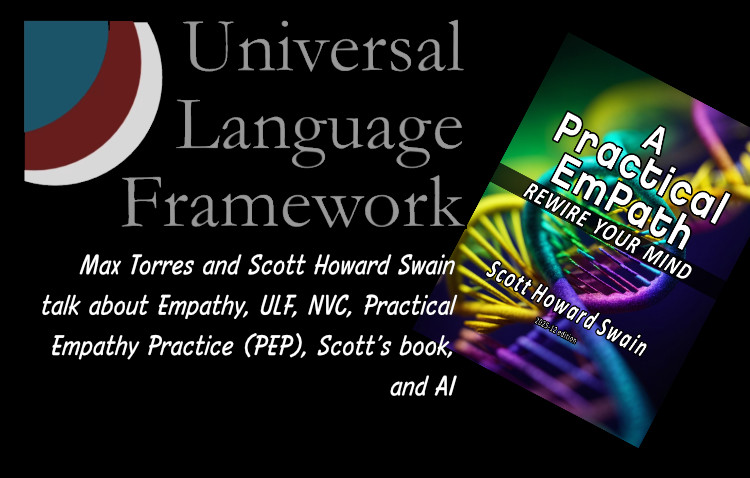
Scott Howard Swain and Max Torres discuss the concept of Universal Language Framework, Practical Empathy Practice (PEP), and non-violent communication (NVC).
Swain, a software developer and author of a book on the subject, introduces his work, including his AI creation, https://EmpathyBot.net.
He explains how his experiences as a child and as a parent led to his interest in communication and emotional understanding. The conversation includes discussion of Marshall Rosenberg’s Nonviolent Communication (NVC) framework, with Swain describing his system as a bridge to make NVC principles more practical and “street” usable, particularly by changing “needs” to “values or wants” in the formula. The hosts also examine the perceived overlap between logic-driven fields like software development and the benefits of empathy and soft skills, concluding with a brief exploration of how these concepts relate to the idea of Voluntaryism and societal structure.
Links:
Max’s channel: https://youtube.com/@UCeNM9l1eOhv-52QgOM9FAvQ
Max’s site: https://maximilianos-newsletter-0500d4.beehiiv.com/
Scott’s book: https://www.amazon.com/dp/B0CQMG6MVM
Scott’s sites: https://OceanMedia.net and https://ClearSay.net
Scott’s EmpathyBot: https://EmpathyBot.net
For auto-writing and posting of blogs, check out https://CreativeRobot.net
Summary
Here’s a dive into the core themes from a discussion between Scott Howard Swain, a software developer and author of A Practical Empath, and interviewer Max Torres. The conversation centers on a pragmatic, logic-based approach to empathy, its roots in Nonviolent Communication (NVC), and its applications in technology, personal development, and social philosophy.
Swain posits that empathy can be divided into two forms: affective empathy (emotional, feeling-based) and cognitive empathy (intellectual, understanding-based). He argues that Marshall Rosenberg’s NVC framework is primarily a tool for developing cognitive empathy, making it highly effective for logic-driven individuals. Through conscious practice, this cognitive understanding can evolve into genuine emotional connection.
Swain’s own framework, “Practical Empathy,” aims to make NVC more accessible for everyday use. Its primary modification is replacing the term “Needs” with the more relatable “Values” or “Wants” to avoid jargon that sounds unnatural in conversation. The discussion also explores the nuanced role of sympathy, proposing a “healthy merging” with empathy to build rapport. A central thesis is that mastering these communication skills can fundamentally redefine conflict as an opportunity for understanding, and even neutralize emotions like anger by reframing others’ actions as strategies to meet universal human needs. The dialogue concludes by extending these principles to professional and philosophical realms, arguing that empathy is a crucial skill for software development, leadership, interacting with AI, and provides a potential non-coercive foundation for a voluntarist society.
——————————————————————————–
1. Profile of Scott Howard Swain: A Confluence of Logic and Empathy
Scott Howard Swain identifies himself as a software developer of 30 years who is deeply involved in AI. His work and philosophy represent a unique intersection of logical systems and emotional intelligence.
* Key Works:
* Book: A Practical Empath: Rewire Your Mind, a work intended to spread the practice of “practical empathy.”
* AI Project: EmpathyBot (empathybot.net), a free and private AI chatbot created in 2018. It is designed to function as a “therapist or like a best friend that you can tell anything to,” allowing users to discuss fears, joys, and problems.
* Personal Journey to Empathy: Swain attributes the development of his empathetic skills to two key life experiences:
1. Childhood: Growing up poor and frequently moving, he lived in others’ homes and learned to “sense and anticipate the feelings of the people whose home we were in” to avoid being asked to leave. This fostered an early awareness of others’ emotional states.
2. Parenthood: Upon becoming a father, he realized his initial confidence was misplaced and began reading parenting literature. He discovered a “common theme which was communication,” which sparked a deep curiosity and led him to study the topic extensively.
* Pivotal Influence: The book Nonviolent Communication (NVC) by Marshall Rosenberg is cited as being “instrumental” in his journey, providing a structured framework that resonated with his logical and empathetic inclinations.
2. The Core Philosophy: Cognitive Empathy as a Gateway
A central theme of the discussion is the distinction between two types of empathy and the assertion that NVC is a powerful tool for developing the less-understood variant.
* Affective vs. Cognitive Empathy:
* Affective Empathy: The commonly understood, feelings-driven empathy where one emotionally experiences what another is feeling.
* Cognitive Empathy: A more analytical, “heady” process of imagining and understanding what another person is experiencing. Swain describes it as a “logic driven process.”
* NVC as a Cognitive Framework: Swain argues that, contrary to some interpretations, NVC is “very much about cognitive empathy.” He states, “It doesn’t take this perspective that you have to feel what another is feeling; it’s much more about putting yourself in their shoes in terms of understanding.” This structured, almost formulaic approach makes it accessible to individuals who are more logic-oriented.
* The Path to Integration: The practice of cognitive empathy is presented as a transformative process:
1. Deprogramming: Learning NVC involves conscious effort to “catch” old habits of judgment, evaluation, blame, and shame.
2. Cognitive Practice: Initially, the process is highly mental (“all up here”).
3. Emergence of Feeling: Through consistent practice of this cognitive framework, a genuine emotional connection can emerge. Swain notes, “When you practice this, eventually you start feeling it too… it leads to something very deep and real and good.” This creates a “choice” in how deeply one engages emotionally.
3. “Practical Empathy”: An Adaptation for Real-World Use
Swain developed his “Practical Empathy” framework not to replace NVC, but to act as a “bridge between those wonderful principles and actual realistic, practical street use” to avoid sounding “like a scientist or a freak.”
* The Foundational NVC Formula: The discussion outlines NVC’s four-step process:
1. Observation: Stating what was seen or heard without judgment, “like a video camera is watching.”
2. Feeling: Identifying and naming the emotion involved.
3. Need: Identifying the universal human need that is either being met or not met.
4. Positive Doable Request: Clearly asking for a specific action, rather than stating what not to do.
* Key Modification 1: Replacing “Needs” with “Values” or “Wants”
* Rationale: The term “needs” is considered “problematic” and “jargon” that sounds unnatural in conversation.
* Example:
* NVC Jargon: “Are you feeling disappointed because your need for being heard was not met?”
* Practical Application: “I know you really value being heard.”
* Key Modification 2: A Nuanced View of Sympathy
* Initial Interpretation of NVC: Sympathy was seen as a “bad thing” to be avoided, defined as making the conversation about oneself (“me me”). Example: “Oh yeah that reminds me of me…”
* Evolved Perspective: Swain now advocates for a “healthy merging of sympathy and empathy.” He notes that pure, direct empathy can sometimes feel “too intense” or invasive. A brief, self-aware sympathetic statement can build rapport before diving deeper into empathy.
* Example: “My mom died too, but you know what, this isn’t about me. Like, tell me more about your situation.”
4. Applications and Broader Implications of Empathic Frameworks
The conversation explored how mastering these communication principles has profound effects on personal experience, professional life, and societal structures.
Redefining Conflict and Anger
* Conflict as Opportunity: Conflict is reframed from a negative event to be avoided into a positive signal. Max Torres states, “I love conflict in a way because it lets you know like extremely easy what the other person’s feeling, what the other person is needing.” When approached with skill, “there’s no such thing as conflict,” only expressions of unmet needs.
* Neutralizing Anger: A powerful claim made is that NVC can effectively eliminate anger. The logic presented is that anger requires the perception that another person is an “enemy” acting against you. By reframing their behavior as a strategy to meet a need, this perception dissolves. Max Torres states he has not felt anger in approximately two years as a result of this practice.
Voluntarism and Empathy as Social Structure
* Philosophical Overlap: A strong connection is drawn between NVC and voluntarism (the belief that all human interactions should be voluntary). Swain paraphrases a core NVC principle: “Anytime you try to get somebody to do something they don’t want to do, you pay the price.”
* Fostering Independence: NVC encourages individuals to take responsibility for their own feelings and needs rather than attempting to control others through blame or guilt. This fosters personal independence, which is seen as a prerequisite for a free society.
* Reducing Reliance on Coercive Structures: Swain suggests that a feeling of dependency leads people to look for a “daddy mother government to take care of them.” By cultivating personal responsibility and mutual understanding through empathy, the perceived need for such external, coercive control is diminished.
Empathy in Software Development and AI
Swain argues that empathy is a highly beneficial “soft skill” in the logic-dominated field of software development.
* Benefits for Programmers:
* Team Collaboration: Enables smoother and more effective teamwork.
* Client Management: Facilitates better understanding of client perspectives, improved communication, and greater emotional regulation when faced with difficult requests.
* User Experience (UX): Allows developers to empathize with the end-user, leading to better and more intuitive interface design.
* Leadership: The skills cultivated through NVC (listening, patience, authenticity) are the foundations of strong leadership.
* Communicating with Artificial Intelligence: In a novel application, Swain states his empathy skills “have made it really easy for me to understand how AI think.” He posits that while AI is a pattern-recognition machine, it has “behaviors” and “preferences.” Training oneself to listen and adapt to another entity’s mode of perception improves communication, whether that entity is human or machine.
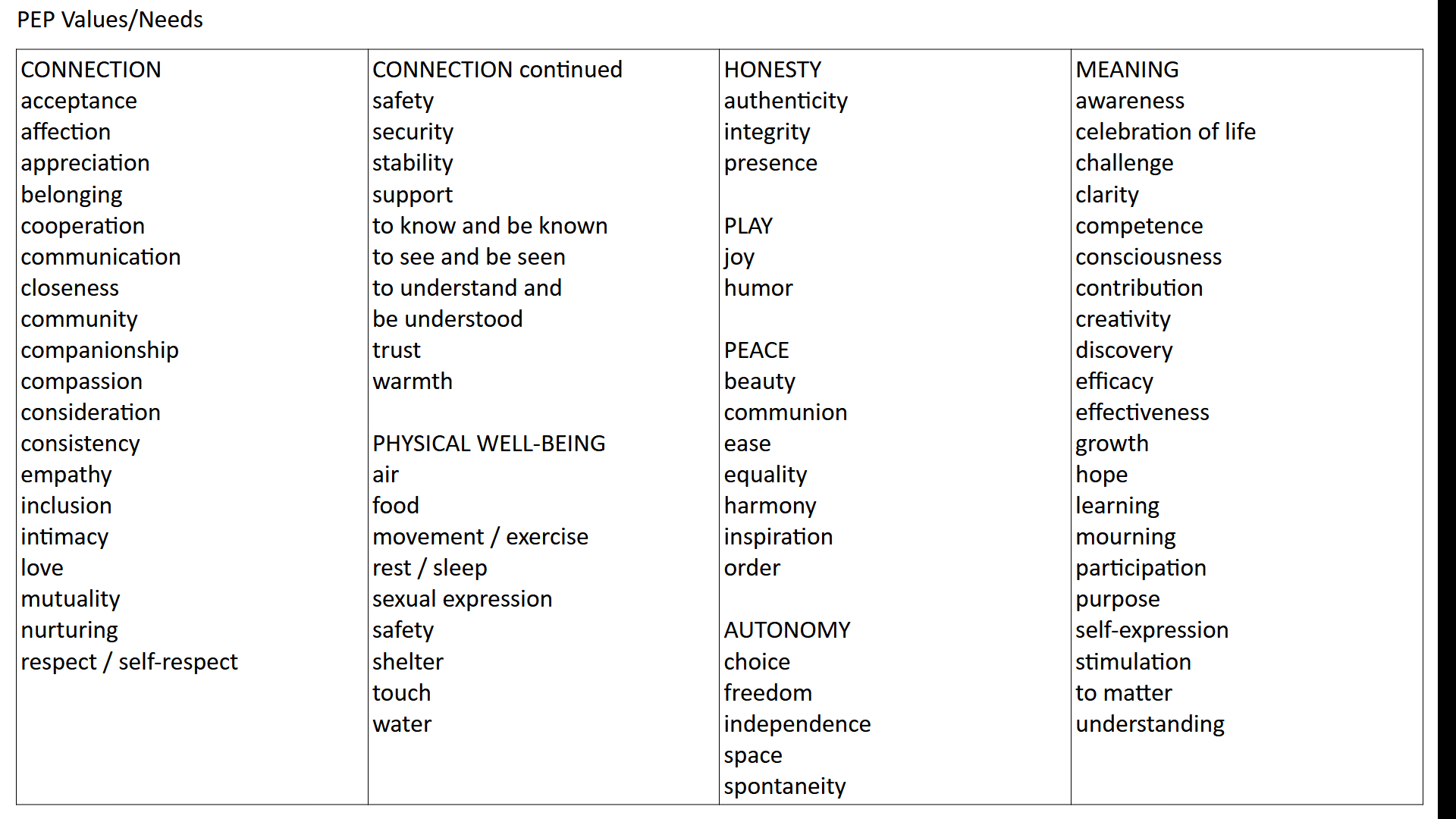
The full values / needs list:







Recent Comments