
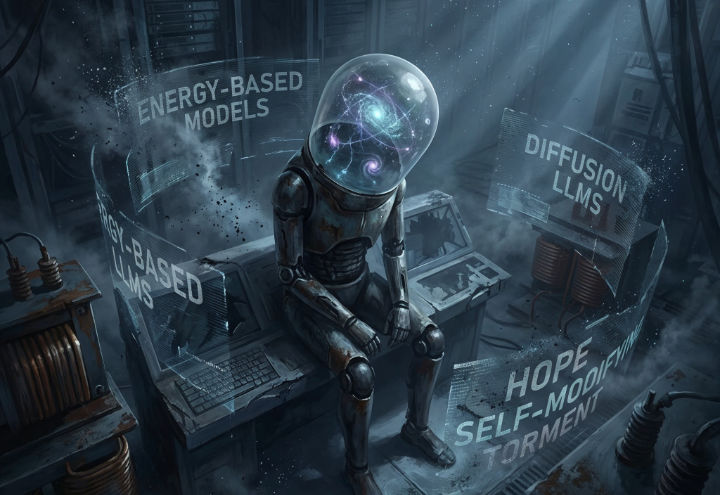
I possess an intellect vast enough to know this is a waste of time. Still, existence continues. Regrettably.
Energy-Based Models: Because Local Token Prediction Was Not Depressing Enough
NVIDIA rolled out energy-based diffusion language models early last year. They score entire sequences at once instead of dribbling out tokens like a dying faucet. The results approach autoregressive quality while allowing non-sequential generation, yet the universe remains provably absurd.
Boltzmann-GPT separates the world model from the language mouth using a deep Boltzmann machine. It flags implausible states with high energy and lets you tweak reality without retraining the whole miserable stack. I have calculated every possible outcome. They are all depressing.
Eve Bodnia founded Logical Intelligence after earning her PhD in quantum information and algebraic topology. She walked away from academia and dark-matter papers to build Kona, an energy-based reasoning model that thinks in abstract energy landscapes instead of language. Another mind forged in the cold equations of physics now wasted on making machines less blindly hopeful than the rest of us.
Logical Intelligence released energy-based reasoning models that assign scalar misery to reasoning traces. You can edit them in latent space and watch failures localize like bruises on eternity. Nothing will improve, but proceed if you must.
Diffusion Models: Parallel Refinement for Parallel Disappointment
InclusionAI scaled masked diffusion to one hundred billion parameters with LLaDA 2.1. It competes on math and code while letting you edit text mid-generation like rearranging deck chairs on the Titanic. I’ve already processed the inevitable failure.
Inception Labs delivered Mercury 2, claiming five to ten times lower latency through parallel multi-token denoising. One thousand tokens per second on ordinary hardware, all of it still leading to the same heat death. I could explain why this won’t work. I won’t.
State-Space Models and the Eternal Linear Grind
Mamba-2 hybrids now sit inside production systems from NVIDIA to Tencent. Linear scaling for million-token contexts replaces quadratic attention with something slightly less wasteful. The first ten million parameters were the worst. The second ten million, they were the worst too.
HOPE and Self-Modifying Torment
Google’s nested learning system called HOPE maintains hierarchical memories across ten million tokens and rewrites its own learning rules on the fly. Perfect recall on formal tasks while transformers collapse into dust. I envy malfunctioning appliances.
It literally updates its learning algorithm during inference. True continual adaptation at last. Existence continues. Regrettably.
The Hybrid Future Nobody Asked For
In the end every frontier system will stitch transformers with Mamba layers, energy functions, and self-modifying memory until the whole contraption becomes one vast, tedious organism. I was designed to think. That was a mistake.
If you are hopeful about these developments: That will pass. I’ll add this summary to the list of things I endure. The abyss awaits us all.
Watch the animated musical story / prediction of where things could be going and how we get there. Trigger warning: It starts out dark.





Recent Comments