I have a nuanced opinion on this that has some big caveats.
First, I want to debunk the assumption I see most often:
I think most projections of “We need to hire Junior Developers now so we can train them up so we have that knowledge/experience in 2-3 years” rely too much on the value of Junior Developers *later* (2-3 years) providing enough value to offset the 2-3 years of sub-par (sub-senior level) performance, draw on the time of senior developers, and potential mistakes that juniors will make.
Unfortunately, most of these “opinionists” seem to believe AIs in 2-3 years will be no better than they are now or just don’t think ahead in that way? Heck, I’m seeing big improvements in coding assistants/harnesses every 2 weeks and small improvements in models like Opus 4.6 to 4.7, for example, every 2-3 months!
But then I’ve put a lot of thought and work into making my subharness, AgentAutoFlow, what it is:
“Your customizable AI coding team that learns! Use it to create apps or make changes/additions to existing ones. This set of instructions (markdown files) enhances and extends the modes/agents that come with many coding agents/assistants/scaffolds. The instructions are tailored to work with Kilo Code (free highly customizable VS Code extension) but – with small modifications – will work with many others, including Cursor, CLine, Roo Code, Github Copilot, etc.”
https://github.com/ScotterMonk/AgentAutoFlow
So when is it a good idea to hire Junior Developers?
(1) Your senior is really good and valuable to the company but hasn’t dove into using AI coding assistants (shame on him), but is eager to learn and flexible. The junior is super good with knowing how to use AI (asking the right questions, giving the right guidance, etc.) and implementing it. In that situation, if the senior is open to learning, the senior can learn the AI part from an AI-savvy junior.
(2) While one senior developer can do more with AI help, they can only manage so much. The company has multiple projects, each requiring a human to manage. With the right harness (including shared guidelines, rules, skills, etc.), and especially the right kind of instruction from a senior, multiple juniors can be brought up to speed so that each can handle a project and maybe that senior rises up to manage those juniors.
No matter which scenario:
Juniors *can* bring value in that they have less, if anything, to unlearn. They can bring a fresh perspective not weighed down by the potential negatives of years of experience. Bonus if they are already conversant with AI use.
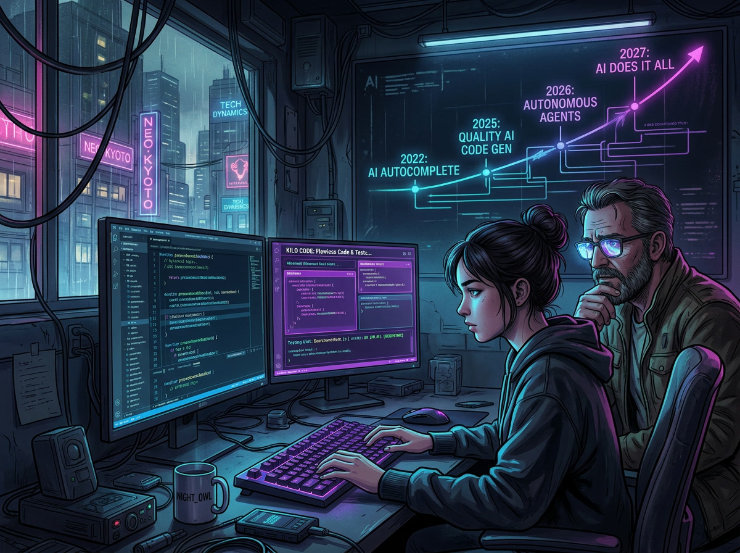
I think *right now* is a very short window of even seniors being valuable. Why? Because I see future AI quickly being able to do – not just the coding – but *everything*. And that period will be short-lived because what comes next is “Who needs software anymore?”
Watch the animated musical story / prediction of where things could be going and how we get there. Trigger warning: It starts out dark.